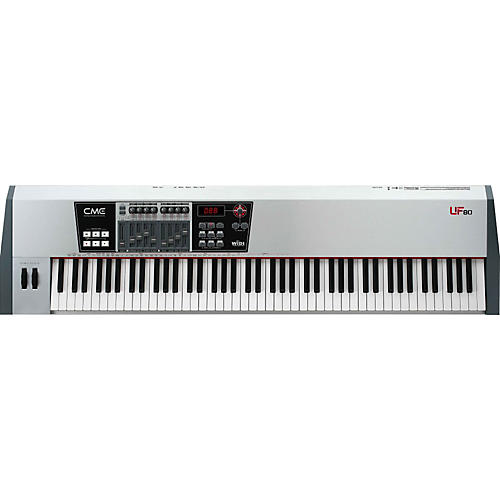

The CME UF80 offers a weighted, hammer-action 88-note keyboard at a knockdown price. Is it too good to be true? CME's new UF family of controller keyboards is comprised of four different models. The UF50, UF60 and UF70 feature 'semi-weighted' keyboards with 49, 61 and 76 keys respectively, offering velocity sensitivity and aftertouch. The UF80, reviewed here, has a weighted 88-key 'Professional Hammer Action' keyboard, which also has velocity sensitivity and aftertouch.
Apart from the keyboard configurations, the different models are functionally identical. The UF80, unsurprisingly, is the largest and heaviest of the bunch, measuring 1408 x 372 x 150mm and weighing in at a daunting 23.5kg. The brushed-aluminium case gives the device a stylish appearance, and should protect against all but the most violent impacts. The top panel is adorned with nine sliders, eight knobs, a basic-but-serviceable LED display, a rotary encoder, a set of six sequencer transport buttons, and a dozen other buttons.
New driver of UF Keyboard for Intel MAC released. 7838 views since 2006-12. Just unzip the file,then run CME-UF-MIDI-1.2u.pkg to install the driver. UF Driver for Intel MAC v1.0. Programma dlya razdevaniya lyudej na foto onlajn7761143. Unzip the file,then run CME-UF-MIDI-1.2u.pkg to install the driver. Used with the CME U-KEY MIDI Keyboard for data transfer and program update.
In addition there are the usual pitch-bend and modulation wheels (the former sprung, the latter not). The back panel features a conventional MIDI Out socket, two quarter-inch jack sockets for connecting expression or sustain pedals, a more unusual eighth-of-an-inch jack socket compatible with Yamaha's BC3 breath controller (I wasn't able to test this), a standard USB port, a socket for attaching the mains adaptor (supplied, although the unit can be powered via USB instead) and a power on/off switch. There's also a blank plate, behind which lies an expansion slot that can apparently be used to install a Firewire expansion board or a sound module expansion board (see the 'Mind Expanding?' The manual provides no information at all about these options, leaving the user to search the CME web site for clues instead. You have a range of options when it comes to connecting the UF80.
Most simply, you can use the standard MIDI output socket provided on the back panel. Alternatively, if you're working with a computer, you can run a standard USB cable from the socket on the back panel.
The UF80 is a 'class compliant' device, so no driver needs to be installed. Once attached, virtual MIDI In and Out ports (one of each) are made available to MIDI-aware applications. The UF80 also has a built-in bi-directional wireless MIDI system, and a small USB dongle is supplied which acts as a receiver for the host computer. The radio frequency and channel are adjustable and maximum operating distance is quoted as being 80 metres 'without obstacles'. Strong srt 100 usb driver. No installation instructions or driver CD are provided, so I just crossed my fingers and plugged it in.

My first attempt failed. My computer (an Intel-based PC running Windows XP) initially saw that a USB device had been attached, then threw up an error message saying that the device had not been recognised.
I removed the dongle, plugged it back into the same socket, and it was properly recognised. A new MIDI interface (identified by Windows as a 'USB Audio Interface') immediately became available. Once installed, the wireless connection worked transparently. I wasn't aware of any perceptible extra latency compared to a cabled connection, and I didn't experience any interference or data corruption (although I'd personally still want to take a USB or MIDI lead along if I was going to try using the keyboard in a 'noisier' environment). Although it works well, I have to say I'm not entirely sure why a wireless MIDI connection is useful.
This is an 88-key keyboard, weighing a little over 23 kilos; you're not going to be strapping it on and dancing about on stage! Once installed in the average studio, a controller keyboard is unlikely to be moved very far or very often. Balancing the inconvenience of occasional re-cabling against the risks of RF interference and software glitches, I think I'd favour the old-fashioned approach. A range of optional expansion boards are available from CME, and all appear to be compatible with the UF keyboard series. More information can be found at.
- Author: admin
- Category: Category